Language is a funny thing. I have talked about it before but the use of language and our ability to reason numerically is so interesting. I had a conversation with a student today where he told me about his dogs. It was one of those off topic conversations. He was describing the size of his dogs and he said "I have two hundred ten pound dogs." Now I have intentionally left out any dashes, because I want to let you in on what I understood. When he said that I thought of this massive group of hundreds of these ten-pound puppies. He meant he had two dogs that were 110 pounds. Which brings me to my thought. In one sentence we can have three different meanings, the likes of which are such. I have: - I have 210 pound dogs
- I have 200 10 pound dogs
- I have 2 110 pound dogs*
What does this tell us about the nature of quantity? They all sound the same but all produce different quantities. In scenario 1 we have 210x pounds of dogs. We do not know how many dogs I have, but they are all around the same size. In scenario 2 I have 2000 pounds of dogginess, and in scenario 3 I have 220 pounds of dogs. In some weird linguistic sense, these seem like they should all be similar in some sense, but they all produce different images, and different quantities entirely. I do not know why this particular quantity pun amuses me so much, but I feel there is something here. * Ya, I realise that mathematically we should say two one-hundred-ten pound dogs, but conversationally we rarely say that. **Another fun quantity pun to ask kids especially is would rather have one and a half million dollars or one million and a half dollars? Something seems eerily the same about those, but they are screamingly different.
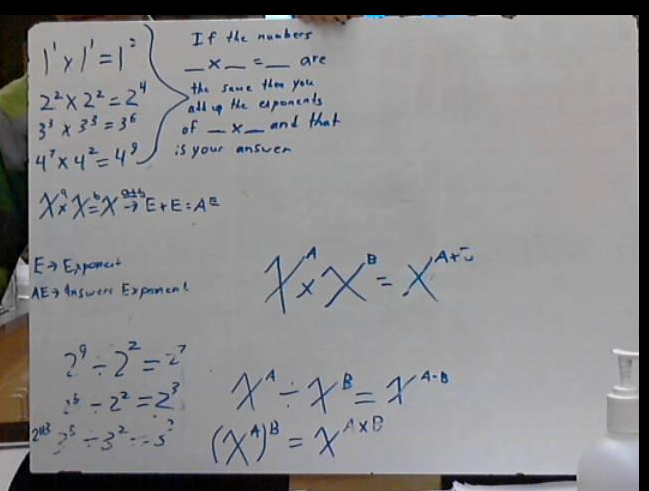
Well Geoff and Michael have been bugging me, and I was also really inspired by Stadel's recent post on exponents that I wanted to quickly share my little intro to exponent rules for my grade eights this year. They (and I) really enjoyed it, and I think it touches a bit on what Dan Meyer is trying to get at with Tiny Math games. In Grade 8 students do not need to know exponents, but our school wants them to be familiar with them, before grade nine, so I concocted this little activity. The Setup Nothing too fancy here, but basically I printed out this sheet multiple times  | exponent_explorations.docx | | File Size: | 15 kb | | File Type: | docx | Download File
 | exponent_explorations.pdf | | File Size: | 63 kb | | File Type: | pdf | Download File
I sliced each section, and put them in envelopes at the front of the board titled "Product Rule," "Quotient Rule," "Power Rule," and a^0=? I told students a few simple directions - Follow the directions on the first slip of paper.
- Complete all directions on your large whiteboard.
- When you think you have it figured have me come and take a picture.
- Practice that rule with some basic worksheets.
- Move to the next rule.
The Inspirations If you can't tell or don't recognize the questions, I was inspired by Exeter. Reading their problems I realise they have a knack for assessing, and teaching within the context of a clear and concise question. The question itself pushes students to work through the problem solving in a natural way (even if it is pure math not applied). I worked on these questions for awhile, to make sure that they put the students through the algebraic clarity but they also had a chance to play and punch numbers in their calculator. (aside) This in my mind is also a less rigorous version of David Cox's fantastic lesson. The Context Students had a concept of repeated multiplication. They knew how to evaluate exponents within whole numbers and could hit the "equals" button on their calculator a repeated number of times. They were not instructed how to find the exponential form of a number (for example they can find 2^3=8 but they had never tried 8=2^3). The Payoffs Since this only needed to be an overview, and we just needed to touch on these concepts I felt that I didn't need to make sure that everyone learned every rule. Most students were very proficient with the product rule and quotient rule, and figured that the power rule would somehow involve multiplication of the exponents.
What students LOVED is that they could work through it "at their own pace" (KA buzzwords I KNOW, but still!). Students struggled through it, but it was set up in a way that was just out of their intuitive reach! The students who arrived at a^0=1 were very easily convinced of that fact, and because of that, I knew I had a winner. The Drawbacks Sure they know the rules, and that is fine and dandy, but do they know the reasons behind the rules? I do not teach associative property in grade eight, and therefore reasoning through WHY these concepts work (at this stage, rather than because my teacher said so, it is kind of because my calculator said so), but I think this is only a small drawback, because students are convinced of these rules, and they feel they are natural because they found them. The rigour can come later. Conclusion I will do this again with students, especially as review. I think it puts them in a state of problem solving that is not to laborious, but also not rote procedural notes. Tell me what y'all think! The MONEY shot!
It has been far too long since I have posted here, and for that I am sorry. To tell you the truth I have been busy, but more than I busy I can admit that I have been a bit down on myself. I still have so much to do to become the nguyeningest teacher that I want to be, and I have been a bit under a rock by recognizing that I am not there. We can talk a big game on these blogs and share all these awesome lessons that work (when they work), but even those great ideas can fall or be used improperly, or rushed to the point that no meaning is taken from them. I am a the point right now where I find myself trying to catch up to all the curriculum that needs to be done, and I don't like that, but I have a professional responsibility to make sure that kids are prepared, so I have to work better and harder than I do at this point. Have I led students through inquiry? Are they engaging with their world? Why can't I be more like (insert awesome blogger/teacher/awesome person name here)? I feel as though I am not measuring up, and that's a hard place to be. So I am introducing volume and I asked them to notice and wonder, and this is what I got... This board of notice and wonder seemed a little too good to be true, so I asked the class (a class who I trust to be honest) this:* Raise your hand to vote. Here are your two options: Did you notice or wonder because you actually want to know, or did you notice and wonder this because you think it is what I want you to notice and wonder? The majority of the students put their hand up for option A. They looked at pop-cans and wanted to know legitimately awesome things. They were curious, and they were taking it seriously. They had cool discussions on why the companies would make these decisions. Now granted, we have talked about pop companies before when we did surface area, and I walked them through that, BUT I can see that they have caught a bit of this math bug. They have caught a bit of the curiosity that I had when driving home and watching road lines whiz by. I am not a perfect teacher by any means. I lose control of my class. I take forever to assess. I give them notes, and I even *dun dun dun* lecture. Not every class is inquiry based. I am not always fully prepared. I am very disorganized. I have more faults than I care to name, but somewhere, hidden under the heap of my self-deprecation is something that has attracted kids toward curiosity. We often say to ourselves "If I but do this ONE thing, it will have all been worth it." Today this board represented my one thing. Today I saw that I am not in the wrong profession; I am not the worst person in the world; I am not a terrible teacher. Today I cast off my self-deprecation and embrace encouragement. *Keep in mind this is ONE of my classes. My morning class was not as indepth.
This lesson is not a feat of great technology. This is not a three act post. This is however something that I am proud of because it was simple, clear, and really really fun. I am in my third year of teaching, and every year I notice misconceptions that I want to get out of students heads. I also want to introduce them to natural understandings of mathematics that transitions students easily to higher level thinking, and higher level mathematics. I love this lesson because I feel as though it did that.
When (plural noun) understand they (adverb) learn! My struggle has been to get kids to understand that a variable is a number. They see x and they think that it is a letter, but I want them to know that it is a number. However, I want them to know that it is any number. Depending on the number we put in, we get a certain outcome. Rather than tell them this, I start with a favourite past time of mine, mad libs.
Students in my class have a vague concept of variable but I am really driving home that a variable can be anything, so I begin with variables in English. I prepared this spread sheet and mail merge document so that they can see clearly how variables work. The paragraph first looks like this: - Once upon a/an «Noun_1», there were three little pigs. The first pig was very «Adjective_1», and he built a house for himself out of«Pl_Noun». The second little pig was «Adjective_2», and he built a house out of «Pl_Noun_2».
And wonderful grade eights turn it into this beauty: - Once upon a fire breathing llama, there were three little pigs. The first pig was very colourful, and he built a house for himself out of cats. The second little pig was scary, and he built a house out of apes.
I talk a bit about programming here and say, "This is what computers do, they take information and insert it where it is supposed to be. Here wherever I have 'Noun 1' what information is stored there gets displayed." I then talk about we get a certain outcome based on the variables we put in. I ask about the first variable 'noun 1', "What if I put in this variable the word 'time'? How would that change the outcome of the sentence?"
"It wouldn't be funny!" Most students say. At which point we move on to our next session... Wow, that _______________________ smells really good!
I tell students here that we are going to use ________________________ as a variable. I give them a chart, and I want them to fill in the chart with variables that produce a factual sentence, a nonsensical sentence, and a funny sentence. Here are a few examples.... Factual | Nonsensical | Funny - Farts
- Cannibalistic Llamas
- bucket of degrading cat carcasses
| At this point you can't help but have wonder and awe at the buy in factor! It goes with out saying that you have to remind students to be appropriate (the cat carcass one is weird, but it made me laugh!), but kids love thinking of these and sharing them. It is important that you wear a/an X before you jump into a pool!
At this point I tell students that they have used variables for ever in math. They have all done 3+__ = 5. The __ is a variable, you can put any number in there (although only one number makes that statement true!). So in this example we do the same thing, but instead of _____________ we now say X. We discuss again what is factual what is not. We can even begin to talk about one to one correspondence (is "speedo" factual or funny? Hint: the answer is yes). But wait, are we not in math class? The jump then becomes ridiculously easy. I have students do the same thing with numbers. There tables now read even and odd (instead of funny and factual), and they insert values of x that produce even and odd. They do three functions: x+3, 3x, and 2x+1.
Now all you wiley math teachers out there are saying Becausewith 2x+1 you get some interesting results. Kids start to X out the even section. Here's where the messing with your kids in a totally awesome way part comes in. Ask them, "you can't find a value that produces an even number?" They say "no it is impossible." You say, "Yes it is." I let the class know that there is a number that works, they just have to 'open their mind' (but not in a hippy way). They rack their brains, and finally asking, "can we use decimals?" to which you respond "is it a number?" because remember a variable means any number. Going even further!
That's right, there's more!
Why stop at odd and even? This I feel is the homerun to this lesson. I gave them first 4x+1>5 and then 2x+11=7. They fill in a true and false table for each of these, and what they notice is fantastic! In the first example students ask, "What about when x=1?" To which I reply, "Is it greater than 5?" "No" "Then is it true?" I had students writing down 1- (-infinity) in the false section. This wasn't 1 minus negative infinity, this was 1 TO negative infinity! In one lesson I had students figuring out inequalities, variables functions, and equations. At that point all we needed to do was show a little notation, and they were totally on board for inequalities and equations. Awesome! I am going to keep giving them these right up until I formally teach them equations (inequalities aren't even touched on in grade 8, but hey, get them ahead!). Because once they get bored of filling these in, we can say, "How can we speed this process up?" Trick them into learning... yes...
 | variables_and_expressions.docx | | File Size: | 22 kb | | File Type: | docx | Download File
This is the worksheet I whipped up. Take it and do WHATEVER you want with it!
I assume I am not the first person to think of this, but just in case I am, this is the game that I played today in class (if you have seen this before tell me in the comments)! The Rules It is pictionary, but with integers! Basically it runs like this. - The teacher has a list of x number of worked out equations involving integers (ex. (-3)+(+2)=(-1)) written on a piece of paper.
- Students in pairs/groups send one person who is the "drawer" to see the equation.
- Students return to their group, where on one mini white board they draw the equation (using a number line or army men [what lesser people call "integer chips"]).
- Other students in the group use their own mini whiteboards to write down the equation exactly.
- When students correctly answer on their whiteboard they send the next student up to the front to receive an equation.
- The process continues until all teams are finished (if you are into rewards give the top team some candy or something).
Why I like it I really want students to understand the models that they are applying to these problems. I feel that drawing it out is way harder for students than "doing it" as they seem to think memorizing mnemonics is true math. It gets students thinking laterally about mathematics, and translating something concrete into something abstract. Other Uses I can easily see using this with algebra tiles, fractions, etc. I really do not think it is for integers alone. What do you think?
In my last post I proposed a possible introduction to order of operations. It was by no means a complete planned lesson, and neither shall this post be. What happened after, I posted on Twitter "how do we teach order of operations as a concept, rather than a rule to be memorised?" My goal was to teach students a reason why multiplication precedes addition, rather than simply saying... Or is that all we can do? It is a convention right? Conventions can still be conceptual The first thing I thought was that the order of operations are not simply a random guess in the dark convention. I do not imagine the world's greatest mathematicians developing this necessary convention by the toss of a coin. Rather, I expected that there is some reason the great minds of the past did in fact decide that there was an optimal way to follow the procedure of calculation now infamously known as BEDMAS or PEMDAS depending on the mnemonic device you have learned. For me the order of operations has always made sense in terms of algebra, and that is exactly what Dr. Math (referenced in paper) claims. Well, great, I want to teach students order of operations conceptually, but they do not know algebra yet, what can be made of this? Terms are the cornerstone My algbraic understanding moves me to discuss terms. The standard convention makes sense in my mind when we discuss terms: 6x+6y. I know that whatever x is, I have 6 of them, same with y, but since I do not know the values of x and y, therefore I cannot complete and simplify this term any further, because I am not given enough information. 6x+6y is necessarily simplified at this moment.
This is a great way to think of the operations, if you know the basics of algebra, but when we teach order of operations, students do not have a strong (if any) concept of a variable and especially like terms. My struggle over the last few days has been this: "How do I reconcile my algebraic understanding of the order of operations within arithmetic?" Models, models, models I think I just heard @fnoschese cheer, but it really comes down to understanding our models of addition and multiplication. When I think of my conceptual understanding of addition, this comes to mind... That is, addition is largely a combining operation. I have this many things here, I have this many things there, I bring them together and TADA! However when I think of multiplication, I think of this... When I think of multiplication I often think in groupings. I do not take a quantity and combine it (like addition), but I create a quantity (seemingly from nowhere) via grouping.
The point that expresses this for me the most is when we look at the number line. With addition we start at a particular number, and then move onward. With multiplication we start at zero! Multiplication is an ex nihilo process, we get something from nothing. With addition we combine two quantities that are there, whereas with multiplication we simply start making groups. I think this is the "multiplication is a stronger" operation argument, but I just had to put it in my terms. Putting it all together, and bringing it back This is not an airtight argument for multiplication to necessarily precede addition, but since order of operations is a convention it need not be. However I think this is my first fruits of grasping why this is a well defined convention, not a coin flip. If I am uncertain of which order to use when given the problem 3x4+2x5, it makes sense to me that I cannot do any addition until I am guaranteed to have separated values that I can combine, multiplication doesn't have that requirement, so logically I can start with that multiplication.
I'd like to hear all of your thoughts on this though. Is there a point to all of this or should we just say, "Bedmas everyone! Look it's bedmas!"? Do you want to get mad at me for my lame models or start the war on multiplication is not repeated addition? Let's talk this through so we can make the order of operations a less daunting, more natural task for students...
I have never introduced students to order of operations. I have always received students after their initial introduction. I always feel like receiving students after their rote memorisation of BEDMAS (or PEDMAS if you call 'em parentheses, or are very apologetic about your kin), means that when I try to let them explore they just default to what they memorised, but they cannot recall that after the lesson. It makes me feel stuck between a rock and a hard place, but I still wonder what the initial introduction can look like. Initiate a Debate One introduction that I have just thought of this morning, I'd like to try. It's heavy on symbols, which I am afraid of, but I think it is basic enough that it might spawn some conversation and debate. I just want to share it and see what you all think. I like it because I feel it introduces students to some manner of proof, and following logical principles, and I think it would be very interesting to see students' misconceptions about the order of operations. Here goes:
Premise 1 Ask the class what is 5+12? What is 12+5? Can we agree that 5+12=12+5?
Premise 2 What is 3x4? Can we agree that 3x4 is another way of writing the number 12?
Conclusion I am going to write something on the board. Tell me if you Totally agree, somewhat agree, somewhat disagree, or totally disagree...
5+3x4=3x4+5
Have students get in groups and say, "give me a knock down reason why you think you are right." The students that I imagine The agree-er- This student believes it, and would focus on the fact that 3x4 is another way of writing 12. This student would be good to play devil's advocate with.
The choose your own adventure - This student says, "If you decide to multiply first it can work, if you work left to right it doesn't." This is pretty easy to counter, ask them to try both ways on just one side of the equation. You get that 5+3x4≠5+3x4, "That seems ridiculous doesn't it? So which one should we choose?"
The reader - We read a book left to right, so we read math sentences left to right as well. This student gets that we need to have a common way to solve all math problems, but does not quite understand the separate operations. (This is the student that I need help with!) Uncharted Waters This is where I have never been and wonder how worthwhile this exchange would be. Would students logically piece it together? Would most students be an agree-er, a choose your own adventure, or a reader? How would I encourage each of these groups to prove themselves and come to a consensus? What questions would you ask your class in this discussion or is this just a bad introduction? What I Hope Students Can Learn? I have been thinking that I would much rather introduce Order of Operations, as terms rather than BEDMAS. This would prepare them for algebra, and would provide a more conceptual understanding of the process. I do not know what the progression would look like, but I assume that beginning with multiplication and addition would be the natural place to start. Where would you go next? Subtraction? Maybe you are thinking, "Timon you are CRAZY, this is HOW you should do order operations." Please tell me about it; I want to know.
This is easily one of my favourite problems that I have come up with. Mainly because of the back story. I handed a student this calculator, and he told me that it didn't work. The numbers weren't working. I showed someone else and they decided to throw it out, but I couldn't help but think that something more than broken buttons was the problem. Act 1 - The Brokenness So ask the students: "What is wrong with this calculator?" or "What is this broken calculator going to give us for '433+233'?" Act 2 - Examples Okay full disclosure here, this is not really what I want to give my students, but as a low tech version (and one that you can use as well), I have made these... What I really want students to do is to explore their own numbers and find patterns on their own. In order to do this, I want to program a base 5 calculator that kids can use on the school netbooks, BUT I don't know how to program. If anyone has ideas about how I could put this calculator into my students hands without telling them that it is a different base please put them in the comments.
The other option is I just put my calculator under the document camera and have students ask and record class wide. That doesn't help you guys though, so this is what I have started with. If you think I need some more/better examples please tell me in the comments and I will make them (groups of four look nice). Act 3 - The Reveal Sequels This is a pretty pure mathematics WCYDWT so I can only think of standard sequels. (Please give me more ideas in the comments, these are pretty lame). - How does multiplication work in this number system? Can you find some easy methods for solving basic multiplication statements?
- Pick a random base (2,7,12,4.5(?), 16), and create some problems, and share them with a partner. What is different and similar among different bases?
- From @trianglemancsd How would you represent 1/2, 1/4, and 1/10 as a "decimal" number? What does 1.3, 1.021, and 0.033 become as a fraction? (All sorts of headaches happen here, clarify a fraction in base 10 or base 5; what does 1/10 mean?
So this one hasn't done absolutely amazing on 101qs.com, but I think that the number of questions that line up together mean that I think we have a worthy entrance into the 3 acts database. The most interesting aspect of this 101qs is not so much the commercial itself, but the outcome of the commercial. The student that actually earned the number of Pepsi points to get the harrier and what happened to that. So let's check it out. Act 1 - The Prizes So when I was a kid and first saw this, I instantly wondered, how much Pepsi would it take to get that Harrier? Also I always wondered, "How much more will it cost to get the Harrier via Pepsi rather than just purchasing it?" Youmight notice that the new version of this video (based on some comments) that I blocked out the points so that students can come up with the number themselves. How could you offer this prize and still make a profit? Act 2 - The Deets A couple of ways I would do this is have students look up some of these items to get a general sense of price to point conversion. Then we can compare that to point to price in Pepsi. This task is more about making reasonable decisions rather than finding the exact correct answer. Act 3 - The Reveal I am a bit worried about this reveal, because being right is always so much more fun, but seeing this we can talk about how completely unreasonable this deal is. There is no way Pepsi would give away this kind of prize for so little. Enter the... Sequels The whole reason I choose this task is that a 21 year old student actually came up with the points necessary for the Harrier. These are some of the questions I would ask. - You are a lawyer for Pepsi, trying to show that this commercial is clearly a joke, and not a real offer. Prepare a statement for the judge.
- What is the least amount of money that the 21 year old could pay for the Harrier, assuming he purchased bottles and cans to obtain the points?
- Pepsi offered a deal, that you could buy a point for 10 cents. How much could you get the Harrier for? (Yes this is an easy sequel for math teachers, but I know a few students that would have to think about it).
So a bunch of mathy people are going to be meeting up pretty soon here. Yes, that’s right Twitter Math Camp is near, and since I am not going I wanted to give something to the blogosphere in solidarity. Step one to this is creating #TwitterJealousyCamp for anything awesome from TMC that I simply must retweet. The second step is creating this nifty guide that I have had in my head for awhile, but never found the time to write. It is not so much for meeting at Math Camp (but may come in handy for some), but rather the “Hey let’s go for coffee, I’m in town” type of tweet ups. This guide is based mostly on true events. Without further ado, here goes...
Step 1 - Decide on a Meeting Location
This is natural. You want to meet, and assuming you are meeting in a real space-time type spot, then it is simple. Choose your location, clarify it, double clarify it, and get there! Not much left to say here.
Step 2 - Ponder upon the Fact that you may be Meeting up with a Murderer
Remember when you (or your kids) first went on things like chat rooms (anybody remember those things? It was like Twitter, but in a ‘room’)? You learned early on that anyone to whom you were talking was probably a serial killer, a crazy stalker, or some other predator. Yet at some point, after you have set this meeting location, you realise that you completely forgot about your internet safety knowledge from the nineties. A good time to remember these rules and ponder the horrors of what will most assuredly befall you when you meet @mathymurder is usually on public transit on the way to your meeting.
I thought @iheartAXES just really liked both x-axis AND y-axis... I’ve made a horrible error.
It’s all right though; I've thought through this for you. Imagine a person goes through thirteen years of grade school and secondary school, and somehow comes out with the desire to teach. Then this person goes to 5 more years of school to prepare to become a teacher. They teach for a bit, become a blogger and member of Twitter only to lure other Math teachers into a Starbucks for a tweet up so they can bisect you?
Cool cover-up story bro!
Ya, I think that’s pretty ridiculous too.
Step 3 - Find Whomever You Are Looking For
So you have now arrived at your destination, and now you are trying to figure out if the person walking in your general direction is the person you are meeting. You check their Twitter account and study every detail of it; you have memorised every aspect of their face, and now you know it is them. Unfortunately, Twitter profile pics tell you absolutely nothing about what they look like. Sure many people have a picture of their actual face, but that means nothing. There is a very simple rule to follow when you are sitting there waiting for your tweep to show up. If you think it is them, it’s not. The converse of this rule is also true; if you think they are not the person, they are. Once you decide, one way or the other, the wave function collapses and you are wrong.
I’m certain that she’s @jedimathter, therefore she is not. Now that I know she’s not; she is...
This scenario ultimately leads to sitting beside your tweep for fifteen minutes without realising. If you want to avoid this, be very clear about who you are and when you arrive (I’ve been told that I need to let people know I look like a hipster, so now you know), or use this hilarious misunderstanding as the great ice breaker to avoid the inevitable and awkward...
Step 4 - Start the Conversation Somehow
… point that you realise this is a real person! Twitter is not some fancy AI created by the Matrix to simulate real social communities online. There are living people out there, and now you get to talk to them. Only this time, you can’t wait an hour to get just the right amount of wit, insight, and the always awesome meta hashtag to show that you rock at this communication thing. Nope, now you have to interact with this person in real time. Do you start with Math? Do you ask what their favourite TV show is? I don’t know what the surefire way is, but you’ve probably made a fool of yourself online so stop worrying about it now. You’re only in this situation because this person thinks you rock, so just rock out!
Step 5 - If You HAVE to Do Math, Prepare to Fail...
I would almost say avoid doing math in front of your tweeps but let’s face it, that’s ridiculous. We love math we want to do it, and we will do it. As with any opportunity to do what you love in front of others who (at least for me) are better than you at this skill, you will inevitably make a mistake. It’s hard I know, but this will happen. The best part about it too? It will always happen on basic arithmetic. There’s no way around it.
The best way I have found to deal with this situation (it really helps in every social situation when people put your numeracy skills into question) is to come up with a catch phrase to humourously explain away your folly. Mine is “Oh, I’m good at math; I just suck at arithmetic.” What works especially well with this technique is the conversation can be instantly diverted toward talking about how calculation and arithmetic is only one small part of the great world of mathematics. This works to show that you really get "it," and also detracts from your inability to do the math that you probably penalise your students for forgetting (hypocrite!). Plan B, practice your darn arithmetic! Step 6 - Winding DownSo you have just finished your three hour long coffee, solved all of education’s problems, reminisced about tweets and blog posts of yesteryear, and now it is time to part ways. Congratulations you have survived your tweet up, but you cannot forget the most important step. The post-tweet-up tweet. There are three important things you must remember about the post tweet-up tweet. - You cannot start the post-tweet up tweet, until you no longer have visible contact with the person. Doing so before hand is like saying good bye to someone and proceeding to walk beside them for five minutes; it is always awkward.
- Be polite and let them know how awesome they are. Don’t forget to mention any funny little anecdote that may have occurred.
- Make others jealous! I don’t think I have officially done such a thing before, but I know that whenever I read about tweet-ups I instantaneously wish I could be there, so I am assuming that this is an unwritten, but now written, rule of the post-tweet-up tweet.
And there you have it. If you follow these simple steps you will have a great time meeting all those crazy people on the interwebs that have a fascination with this great and crazy world of education. It’s good to know that I am in such fine company, and I hope you all know it too!
|