I have a penchant for dinosaurs and monsters that roamed the Earth millions of years ago. I still remember sitting in the theatre when I was six years old to see Jurassic Park. I remember the first moment that I saw the Brachiosaurus in that movie and ever since I was hooked! I have never grown out of that. Watching Jurassic Park still makes me giggle like a school girl. When I see things like quake circles in glasses of water, and the piercing cry of the velociraptors, my heart soars!. Suffice to say when I first learned of something called the Megalodon I was hooked. Here are my 3 acts.
Act 1- Say "Ahhh!"
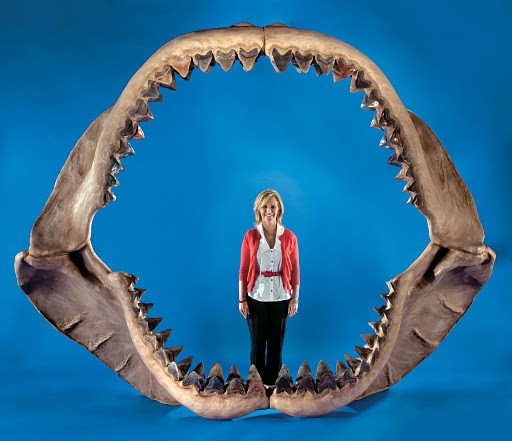
Megalodon was a shark: a really really big shark. What is different about finding remains of a shark than say that of a Tyrannosaurus is that a shark is mostly cartilage. That means that scientists mostly only get to find jaws and teeth.
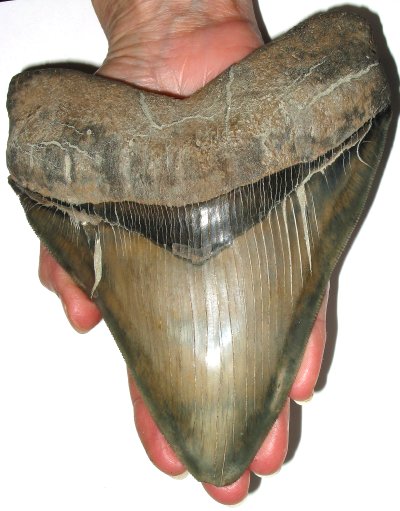
So I want to ask students: "If you found a tooth this size, how big would the shark be?" *Side note for extra awesome go buy a replica on ebay!* Get guesses, draw pictures! Give them a grid to show scale between you and the size of the shark, all in the name of awesome!
Guiding Questions
- If we know this is a shark what is the next step that we should take?
- What sharks could we compare it to?
- Which shark looks most like Megalodon's? Check here maybe.
- How can we compare the sizes of these teeth?
- How does that affect the shark's size?
Act 2 - The Scientific Process
Now experts recognized that this is a shark tooth by comparing it with one of the fiercest sharks around. The Great White shark actually shares much the same characteristics as the Megalodon. Hopefully students will recognize that if we have identified it as a shark tooth that we can compare it to these sharks. This is where some comparison pictures come into play.
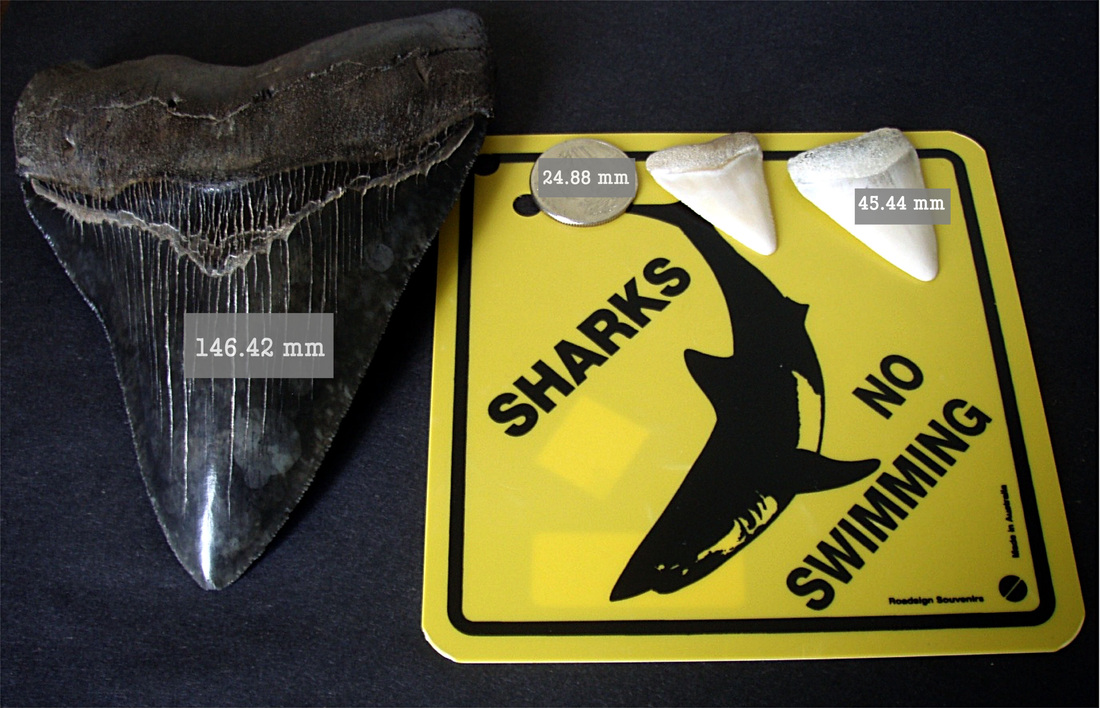 |  |
Students now can make some educated guesses, and we can talk about what are some good methods for estimating Megalodon's size.
Act 3 - The Reveal
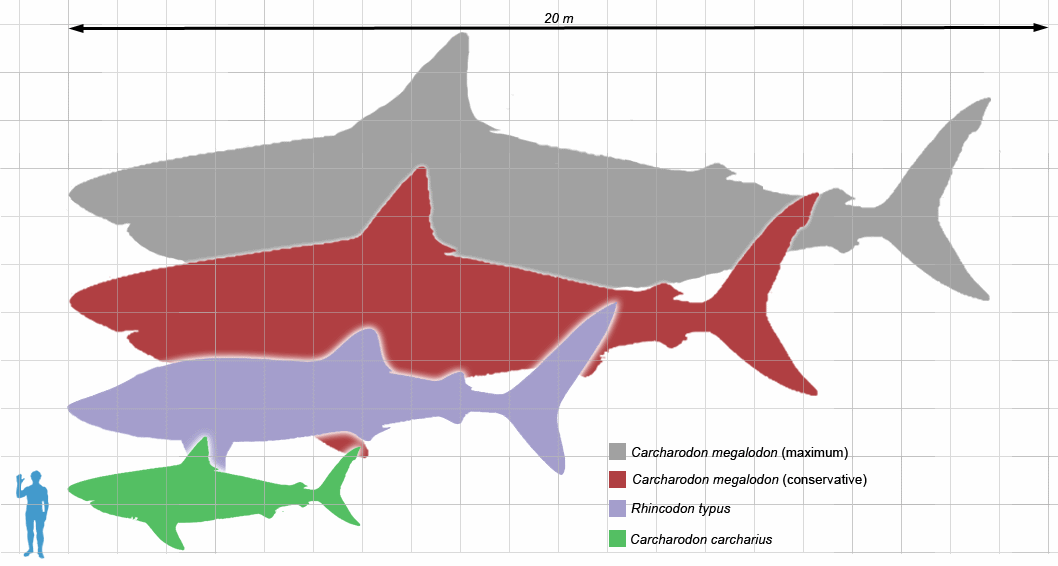 | 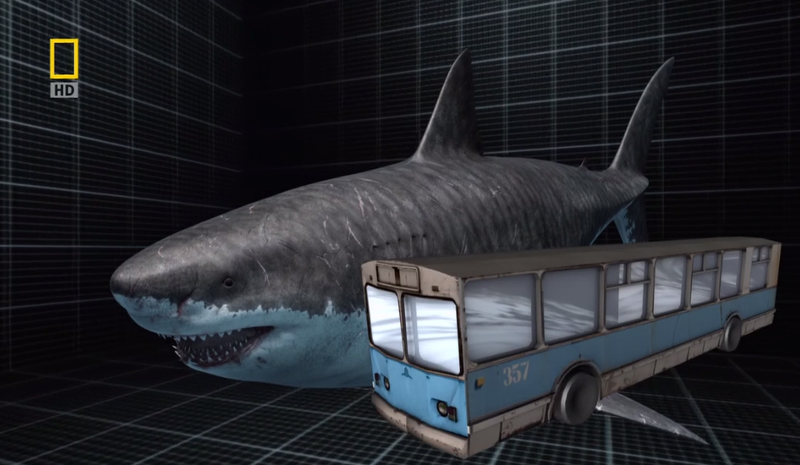 |
The first estimations were done very simple proportional reasoning, which gives us the overestimate. At this point I might have students measure out on a string how big the Megalodon actually is!
Sequels
There are a few sequels that come to mind.
- Given a length of a shark, draw the size of its tooth.
- Experts thought that assuming a directly proportional relation was not accurate measurement. Some experts (Gottfried et al.) found the following information to create a formula that predicts the size of a shark. Use the information in this table to find the equation, and use it to make a new estimation of our Megalodon's size.
| Tooth Size (cm) | Shark Length (m) |
| 2.5 | 2.2 |
| 3.8 | 3.4 |
| 5.1 | 4.7 |
| 6.4 | 5.9 |
Well tell me what you think! I am so excited about this, but will it translate? What do ya think?

