This is easily one of my favourite problems that I have come up with.  Mainly because of the back story.  I handed a student this calculator, and he told me that it didn't work.  The numbers weren't working.  I showed someone else and they decided to throw it out, but I couldn't help but think that something more than broken buttons was the problem.

Act 1 - The Brokenness

So ask the students: "What is wrong with this calculator?" or "What is this broken calculator going to give us for '433+233'?" 

Act 2 - Examples

Okay full disclosure here, this is not really what I want to give my students, but as a low tech version (and one that you can use as well), I have made these...
What I really want students to do is to explore their own numbers and find patterns on their own.  In order to do this, I want to program a base 5 calculator that kids can use on the school netbooks, BUT I don't know how to program.  If anyone has ideas about how I could put this calculator into my students hands without telling them that it is a different base please put them in the comments.

The other option is I just put my calculator under the document camera and have students ask and record class wide.  That doesn't help you guys though, so this is what I have started with.  If you think I need some more/better examples please tell me in the comments and I will make them (groups of four look nice).

Act 3 - The Reveal

Sequels

This is a pretty pure mathematics WCYDWT so I can only think of standard sequels. (Please give me more ideas in the comments, these are pretty lame).
  • How does multiplication work in this number system?  Can you find some easy methods for solving basic multiplication statements?
  • Pick a random base (2,7,12,4.5(?), 16), and create some problems, and share them with a partner.  What is different and similar among different bases?
  • From @trianglemancsd How would you represent 1/2, 1/4, and 1/10 as a "decimal" number? What does 1.3, 1.021, and 0.033 become as a fraction? (All sorts of headaches happen here, clarify a fraction in base 10 or base 5; what does 1/10 mean?
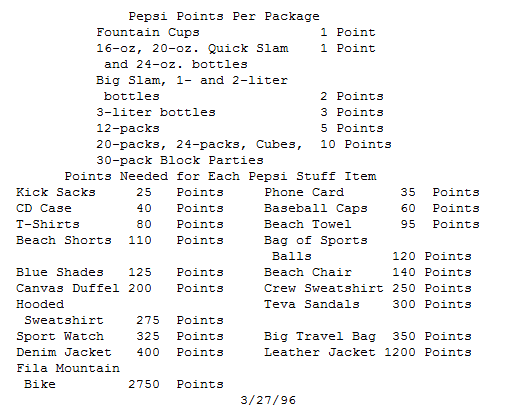
 
 
So this one hasn't done absolutely amazing on 101qs.com, but I think that the number of questions that line up together mean that I think we have a worthy entrance into the 3 acts database.

The most interesting aspect of this 101qs is not so much the commercial itself, but the outcome of the commercial.  The student that actually earned the number of Pepsi points to get the harrier and what happened to that.  So let's check it out.

Act 1 - The Prizes

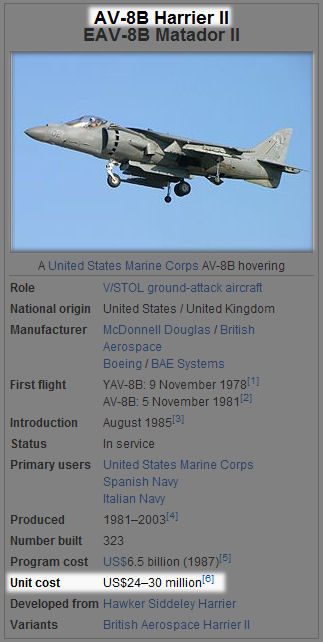
So when I was a kid and first saw this, I instantly wondered, how much Pepsi would it take to get that Harrier? Also I always wondered, "How much more will it cost to get the Harrier via Pepsi rather than just purchasing it?" Youmight notice that the new version of this video (based on some comments) that I blocked out the points so that students can come up with the number themselves.  How could you offer this prize and still make a profit?

Act 2 - The Deets

A couple of ways I would do this is have students look up some of these items to get a general sense of price to point conversion.  Then we can compare that to point to price in Pepsi.  This task is more about making reasonable decisions rather than finding the exact correct answer.

Act 3 - The Reveal

I am a bit worried about this reveal, because being right is always so much more fun, but seeing this we can talk about how completely unreasonable this deal is.  There is no way Pepsi would give away this kind of prize for so little. Enter the...

Sequels

The whole reason I choose this task is that a 21 year old student actually came up with the points necessary for the Harrier.  These are some of the questions I would ask.
  • You are a lawyer for Pepsi, trying to show that this commercial is clearly a joke, and not a real offer.  Prepare a statement for the judge.
  • What is the least amount of money that the 21 year old could pay for the Harrier, assuming he purchased bottles and cans to obtain the points?
  • Pepsi offered a deal, that you could buy a point for 10 cents.  How much could you get the Harrier for? (Yes this is an easy sequel for math teachers, but I know a few students that would have to think about it).
 
 
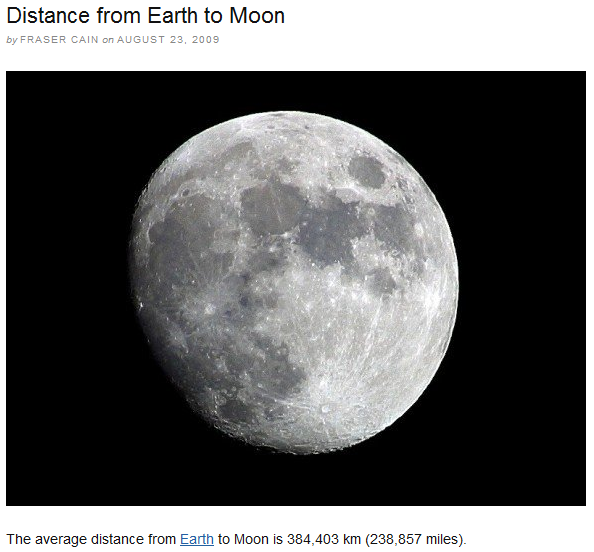
Like so many good things that I have created in life, this post comes entirely from someone else's idea.  Dan Meyer had the first speed of light task, which I am linking for my sequel ideas, because, well, his just rock.  I wanted to include this post, because I feel like I will be able to use this version a lot easier in my grade eight class, it allows talking about cool conspiracy, moon landing stuff, Mythbusters, and is practice for me taking something that I see and turning it into something I can use in class.

Act 1 - The "Laser"

I love this set up because it is what scientists actually did!  They have reflectors on the moon at which you can shoot your lasers and receive signals back to prove that people were on the rock that is orbiting our Earth! Well, now all we need to know is how long did it take for the laser to to hit the moon and come back?

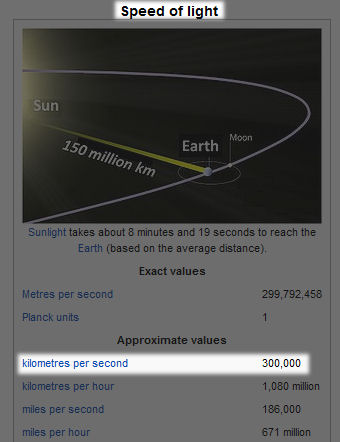
Act 2 - The Measurements

This act two is simple, I would probably use this for a started (shouldn't take too long at all), but here they are...

Act 3 - Fire the "Laser!"

Well there it is; a simple fun intro to the speed of light.

Sequels

As promised, Dan has some awesome work with the same problem, which can be found here.  Check it out, you won't be disappointed.
 
 
I have a penchant for dinosaurs and monsters that roamed the Earth millions of years ago.  I still remember sitting in the theatre when I was six years old to see Jurassic Park.  I remember the first moment that I saw the Brachiosaurus in that movie and ever since I was hooked!  I have never grown out of that.  Watching Jurassic Park still makes me giggle like a school girl. When I see things like quake circles in glasses of water, and the piercing cry of the velociraptors, my heart soars!.  Suffice to say when I first learned of something called the Megalodon I was hooked.  Here are my 3 acts.

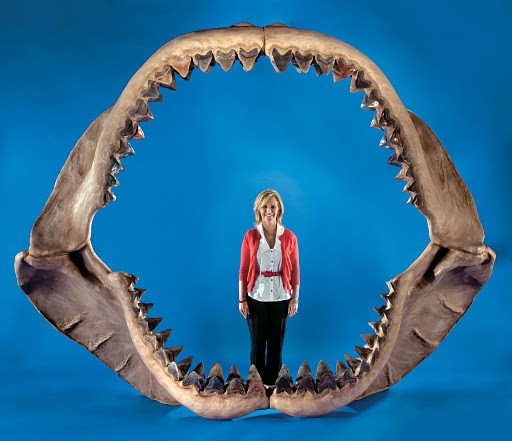
Act 1- Say "Ahhh!"

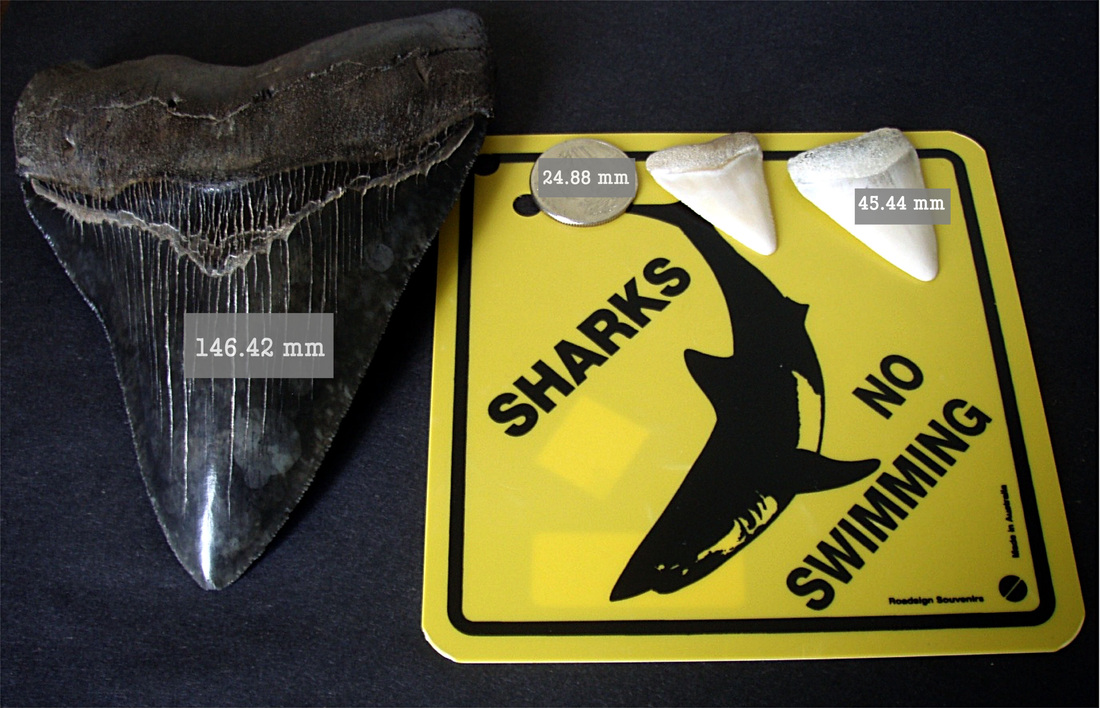
Megalodon was a shark: a really really big shark.  What is different about finding remains of a shark than say that of a Tyrannosaurus is that a shark is mostly cartilage.  That means that scientists mostly only get to find jaws and teeth.
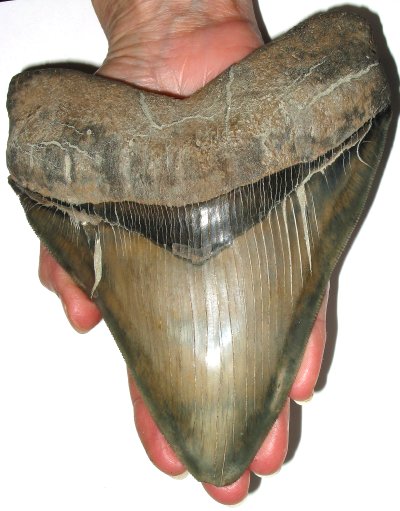
So I want to ask students: "If you found a tooth this size, how big would the shark be?"  *Side note for extra awesome go buy a replica on ebay!* Get guesses, draw pictures! Give them a grid to show scale between you and the size of the shark, all in the name of awesome!

Guiding Questions

  • If we know this is a shark what is the next step that we should take?
  • What sharks could we compare it to?
  • Which shark looks most like Megalodon's?  Check here maybe.
  • How can we compare the sizes of these teeth?
  • How does that affect the shark's size?

Act 2 - The Scientific Process

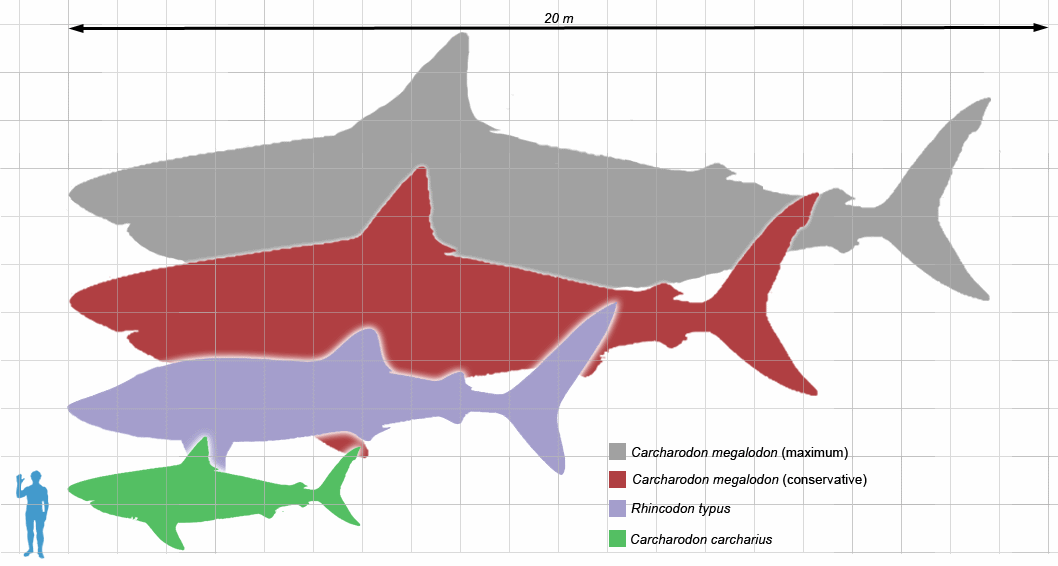
Now experts recognized that this is a shark tooth by comparing it with one of the fiercest sharks around.  The Great White shark actually shares much the same characteristics as the Megalodon.  Hopefully students will recognize that if we have identified it as a shark tooth that we can compare it to these sharks.  This is where some comparison pictures come into play.
Students now can make some educated guesses, and we can talk about what are some good methods for estimating Megalodon's size.

Act 3 - The Reveal

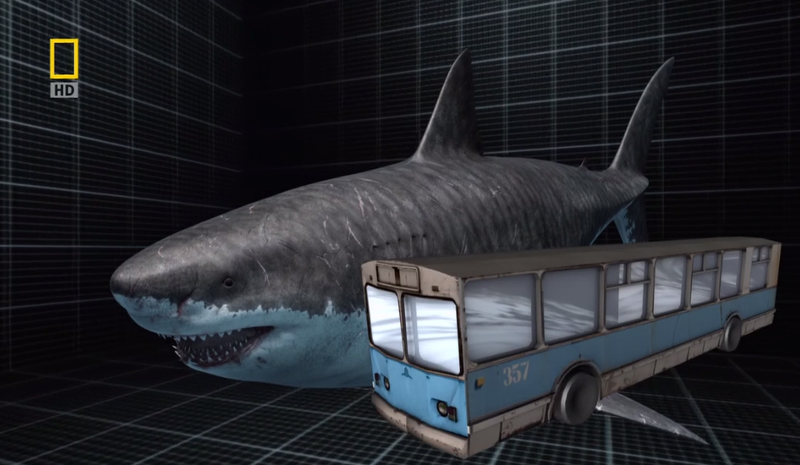
The first estimations were done very simple proportional reasoning, which gives us the overestimate. At this point I might have students measure out on a string how big the Megalodon actually is!

Sequels

There are a few sequels that come to mind.
  • Given a length of a shark, draw the size of its tooth.
  • Experts thought that assuming a directly proportional relation was not accurate measurement.  Some experts (Gottfried et al.) found the following information to create a formula that predicts the size of a shark.  Use the information in this table to find the equation, and use it to make a new estimation of our Megalodon's size. 

Tooth Size (cm)Shark Length (m)
2.5 2.2
3.8 3.4
5.1 4.7
6.4 5.9

Well tell me what you think!  I am so excited about this, but will it translate?  What do ya think?