Ever wonder why companies make the decisions that they do? My wife and I drink more pop than I am willing to admit, and one thing I noticed while at the store is that the twelve packs of Coke and Pepsi do not have the same design. Let's look at them (warning I do not know if this works in the States). This is also a precursor to this lesson.
Act 1 - The Boxes
I asked my students which one uses the least amount of cardboard, and in relation, which company made the best choice for the environment?
This was a good starter. I had kids talking about which looks bigger, and a trend over at least two classes (I'll see later on in the future), is that the majority of students say that Pepsi is the clearer waster, or they have equal amounts of carboard.
This was a good starter. I had kids talking about which looks bigger, and a trend over at least two classes (I'll see later on in the future), is that the majority of students say that Pepsi is the clearer waster, or they have equal amounts of carboard.
Act 2 - The Measurements
I ask students what do we need to know to solve this? Students came up with volume, area, dimensions etc. at which point I introduce them to our cm cubes.
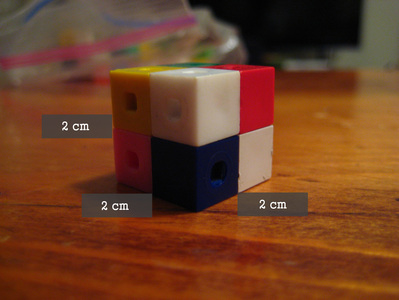
We talk only a little bit about the difference between volume and surface area. In fact I do not use the words in particular, we talk only about "How many cubes are necessary to build this prism?" and "How many squares can we count on the outside?" an idea I lifted from Christopher Danielson. I gave students the following sheet and basically said, GO!

| 
| ||||
Here I talked to students a lot about short cuts. It was great when they said they had no short cuts, and I ask, "You just counted?"
"Yes," replies the student. I then proceed to count one-by-one each outside square. Before I can even get to three, the student interrupts and says, "No, no, no, you times the length by width for one side, then times it by two. You do this for three of the sides, since they each have an equal side" (paraphrased). Bwa ha ha! I laugh to myself, they have it, and I didn't have to write a single formula on the board!
Bringing it back to the pop box now only involves asking, what do we need to know to solve the pop box, problem. Students tell me they need the dimensions of the box so I give them these...
"Yes," replies the student. I then proceed to count one-by-one each outside square. Before I can even get to three, the student interrupts and says, "No, no, no, you times the length by width for one side, then times it by two. You do this for three of the sides, since they each have an equal side" (paraphrased). Bwa ha ha! I laugh to myself, they have it, and I didn't have to write a single formula on the board!
Bringing it back to the pop box now only involves asking, what do we need to know to solve the pop box, problem. Students tell me they need the dimensions of the box so I give them these...
Act 3 - The Reveal
This is also a good time to have students talk about anything we are missing. My wife after a few days of seeing me make this asked about the overlap, and if that makes a difference, I haven't looked into it yet, let your students do it too!
Sequel
- The boxes are designed with the following can configuriations...

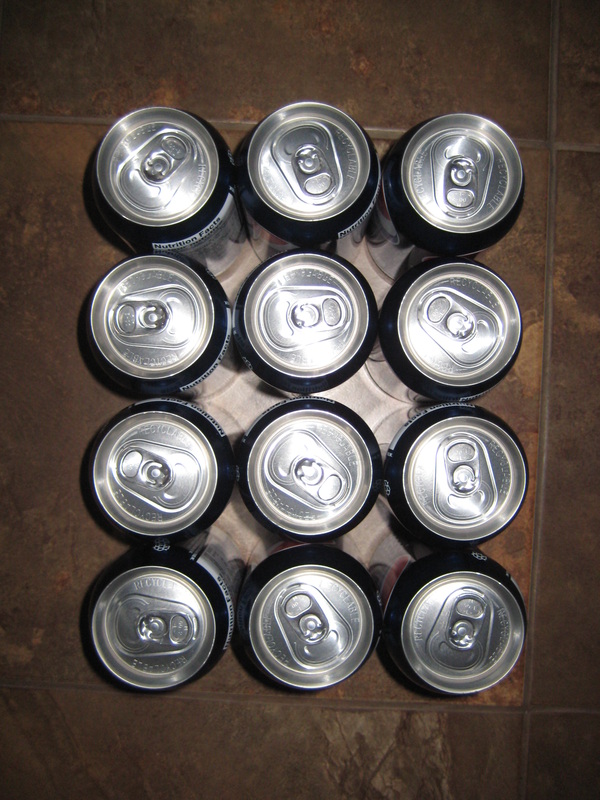
How many different configurations can you find, and which one of these uses the least amount of cardboard? Do any of them use less cardboard than Pepsi and Coke's configurations?
- Write a letter to one of the companies that explains your mathematics. Suggest for them why you think they should switch or keep their design.
Reflections and Moving Further
This was extremely engaging for one of my two classes. I think for me the pay out of the reveal is not as great as most of these 3act stories, so it can lose some students. I want to work on that out for next year.
What else I need to do is to prepare more guiding questions to start off the investigation, so students can be invested in the problem earlier. They have not seen surface area before and so are not acquainted with it. Students knee jerk reaction at this age is to find volume (well actually they just say lxwxh without knowing what that means), so I want to guide them away from that. If they focus on volume to early on they count the problem off to early.
What I really liked about this investigation was the next day when I wanted to teach them surface area of triangular prisms I handed them the nets, and asked what do we have to do now. Students quickly came up with the idea that we needed to find the area of each separate shape and them together. They knew the only formula they needed was to find the area of the triangle. We talked about the relation between rectangles and triangles. This was a fairly easy process, because students can see if you cut a rectangle down the diagonal it makes two triangles (therefore bh/2). This was a fairly simple review of the area of a triangle and extension of their learning of Surface Area. It was fantastic to see how quickly they adapted to the new information! Students were able to further adapt this to other nets that used basic shapes, and it was a very simple natural extension of the same logic (Thanks to Kate Nowak for the idea of nets and surface area).
My only hiccup came with cylinders. I was ill prepared to lead students into a discovery of the area of a circle (technically they learned it last year... but they're only in grade 8), so I fell back onto lameness. I hope to alleviate the lameness, any suggestions? I have learned that great teaching comes from thinking through all aspects of the lesson and leading them through the inquiry. My cylinders lesson bombed, because I was lazy and had little prepared! I was humbly reminded how easily it has to slip into bad teaching, let's change that Timon!
What else I need to do is to prepare more guiding questions to start off the investigation, so students can be invested in the problem earlier. They have not seen surface area before and so are not acquainted with it. Students knee jerk reaction at this age is to find volume (well actually they just say lxwxh without knowing what that means), so I want to guide them away from that. If they focus on volume to early on they count the problem off to early.
What I really liked about this investigation was the next day when I wanted to teach them surface area of triangular prisms I handed them the nets, and asked what do we have to do now. Students quickly came up with the idea that we needed to find the area of each separate shape and them together. They knew the only formula they needed was to find the area of the triangle. We talked about the relation between rectangles and triangles. This was a fairly easy process, because students can see if you cut a rectangle down the diagonal it makes two triangles (therefore bh/2). This was a fairly simple review of the area of a triangle and extension of their learning of Surface Area. It was fantastic to see how quickly they adapted to the new information! Students were able to further adapt this to other nets that used basic shapes, and it was a very simple natural extension of the same logic (Thanks to Kate Nowak for the idea of nets and surface area).
My only hiccup came with cylinders. I was ill prepared to lead students into a discovery of the area of a circle (technically they learned it last year... but they're only in grade 8), so I fell back onto lameness. I hope to alleviate the lameness, any suggestions? I have learned that great teaching comes from thinking through all aspects of the lesson and leading them through the inquiry. My cylinders lesson bombed, because I was lazy and had little prepared! I was humbly reminded how easily it has to slip into bad teaching, let's change that Timon!

